

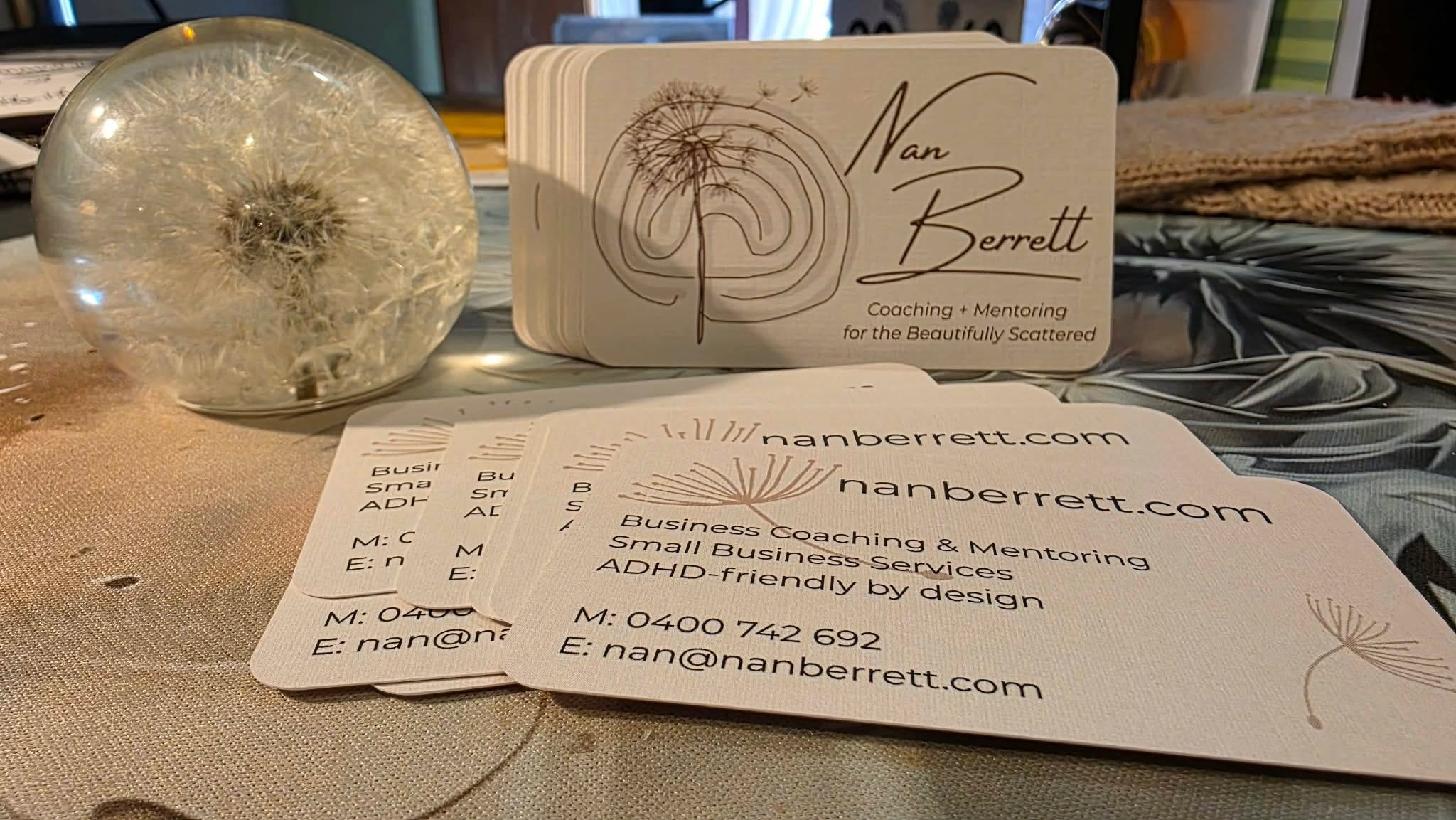
I ordered new business cards, and they came today.
I’ve written about my rebrand journey and the thinking behind it, and for me, part of a solid marketing kit is still the humble business card and I want to share the decision fatigue that came from something as simple as creating a new design for my piece of disposable cardboard.
Because “simple” is doing a lot of heavy lifting in that sentence.
It Started With a Font
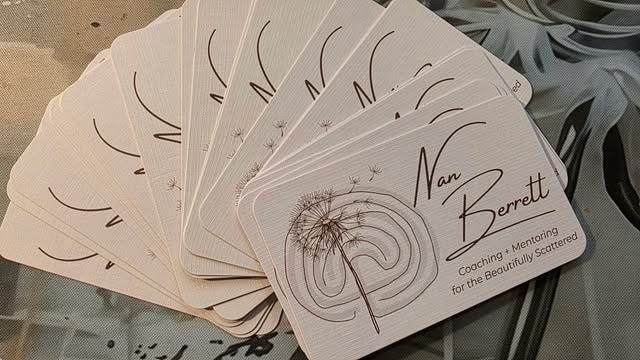
The brief was straightforward enough. New brand, new card. I had my colours, my logo, my tagline. How hard could it be?
I spent the better part of three days changing my mind.
First it was the font. Script or sans-serif? Elegant or accessible? What does “coaching + mentoring for the beautifully scattered” look like in Helvetica versus something with a handwritten feel? I tried them all. I went back to ones I’d already rejected. I asked for opinions. I ignored the opinions. I changed it again.
Then the words. Did I lead with my name or my services? Was “ADHD-friendly by design” too niche? Not niche enough? Would people at a networking event understand what that meant, or would it need explaining? Would explaining it defeat the purpose of the card?
Then the logo. Too big. Too small. Off-centre. The dandelion seeds were getting lost. The labyrinth wasn’t reading clearly enough at that scale. Up 10%. Down 5%. Back to where I started.
Then the stock. Linen or gloss? Matte? Something with texture? And rounded corners - yes to those, definitely, but did the rounding percentage feel right? And how many should I order for the first run? Fifty felt too few. Five hundred felt like hubris. What if I hated them when they arrived?
I changed my mind on all of it. Multiple times. And I am an award-winning former journalist who has filed stories under deadline pressure to national audiences. I can make decisions. This was not a competence problem.
So what was it?
This Is Your Brain on Too Many Choices
Here’s what was actually happening, because the science is genuinely fascinating - and validating.
The part of the brain that manages decisions is the prefrontal cortex, or PFC. It handles planning, weighing options, filtering out irrelevant information and committing to a choice. Research published in the American Journal of Psychiatry found that during decision tasks, people with ADHD activate significantly more brain regions than neurotypical people. The ADHD brain doesn’t decide less - it works harder to reach the same destination. Every choice costs more cognitive fuel than it does for someone without ADHD.
Add the dopamine difference. The ADHD dopamine system functions differently in ways that make it harder to evaluate future rewards against immediate options. This is partly why “just pick one and move on” advice from well-meaning people is both useless and a little bit infuriating. The neurotypical brain has a smoother mechanism for closing a loop. The ADHD brain keeps the loop open, second-guessing, running more laps.
And here is the layer that really got me: research by the ADD Resource Center describes what happens when you combine an already-taxed executive function system with a long string of decisions. Each one depletes your working memory - the mental workspace that holds multiple options in mind while you compare them. By the time I was trying to decide on card quantity, I had already spent that cognitive budget several times over on fonts and logos and stock textures. My brain wasn’t being difficult. It was exhausted.
Psychologist Barry Schwartz wrote about the “paradox of choice” - the counterintuitive finding that more options don’t produce better decisions, they produce more anxiety and more regret. For neurotypical people, too much choice is uncomfortable. For an ADHD brain already running hotter on every decision, it can be genuinely paralysing.
The Perfectionism Trap (And Why Late Diagnosis Makes It Worse)
Here’s where it gets a bit personal.
ADHD and perfectionism shouldn’t logically coexist - one is associated with impulsivity, the other with rigid over-control. But they frequently do, particularly in women who were diagnosed late. When you’ve spent decades having your attention, your organisation and your consistency quietly (or not so quietly) questioned, you develop compensatory strategies. You over-prepare. You check and recheck. You raise the bar on your own work to a height that would exhaust anyone. Perfectionism becomes the armour against being found out.
So when I was agonising over whether the dandelion on my card was 5% too large, I wasn’t being precious about graphic design. I was managing a deeply ingrained fear of getting it wrong in front of people who would then form a judgement about me.
That fear has a name: rejection sensitive dysphoria, or RSD. It’s experienced by the overwhelming majority of adults with ADHD and it describes an intense emotional response to real or perceived failure or criticism. It doesn’t feel like mild disappointment. It feels like a threat. And when the thing you are creating is your brand - your professional identity, the distillation of a major life pivot - RSD turns every micro-decision into a referendum on your worth.
No wonder font selection felt catastrophic.
But Here’s the Thing About Divergent Thinking
There is a silver lining to this, and I want to sit with it for a moment because we don’t always get to the silver lining.
The same ADHD trait that makes decisions costly also produces what researchers call elevated divergent thinking - the ability to generate many possible approaches to a problem. The ADHD brain turns over more stones. It sees more options, more combinations, more “but what if we tried...” possibilities. That’s not a bug in a creative process. It’s a feature. It’s just a feature that needs a reliable off-ramp.
I made a hundred agonising decisions and arrived at something that is genuinely right. The linen stock feels warm and tactile in a way that suits a brand built on human connection. The rounded corners are intentional - nothing harsh or corporate. The dandelion and labyrinth together say something that words alone couldn’t. The “ADHD-friendly by design” line is exactly as niche as it should be, because it’s designed to find exactly the right people.
The creative output was good. The process was brutal. Both things are true.
What Would Have Helped
As a coach who works with neurodivergent business owners, I know the answer to this in theory. I am not always great at applying it to myself, which is perhaps the most ADHD-adjacent thing I can admit.
Constraints help. Give an ADHD brain a broad creative brief and it will explore every corner of it, repeatedly. Give it a narrow one - three font options, not thirty; two layouts, not twelve; a decision deadline - and the cognitive load drops significantly. Structure is not the enemy of creativity. For a neurodivergent brain, structure is what makes creativity possible without the accompanying three days of anguish.
A body double helps. Having someone else in the room (or on a call) while you make decisions creates a container. It introduces a gentle accountability that stops the loop from running indefinitely.
And sometimes, honestly? The best thing is a trusted person who simply says “that one” and refuses to explain their reasoning. Remove the comparison and the decision collapses to a single point.
The Cards Arrived This Morning
They are on my desk right now and they are exactly right. The linen texture, the warm earth tones, the “Coaching + Mentoring for the Beautifully Scattered” sitting quietly under my name. They look like me. They feel like me. Every difficult decision I made during that process contributed to this outcome.
I share this not to perform struggle or to invite sympathy. I share it because I know that somewhere, another late-diagnosed woman is agonising over her website colours or her service page wording or her email signature, and she is wondering what is wrong with her that she cannot simply choose.
Nothing is wrong with her. Her brain is doing something expensive and inefficient and sometimes maddening, and it is also doing something remarkable. The anguish and the artistry live in the same place.
That is what it means to be beautifully scattered.
Have you experienced decision paralysis in your business? I’d love to hear about it in the comments - what decision have you agonised over that probably didn’t warrant three days of your life? You are not alone.
Sources referenced in this article:
For all the struggle behind it, the cards are beautiful and very You. Love that the labyrinth looks like a brain.