

You feel like grabbing a handful of your hair and pulling really hard, but you know it’s not going to help.
It’s common everywhere, and as we get older and wiser we still don’t always manage stress in the best possible ways. When we go into business we’re infused with excitement about the challenges and possibilities, but as time passes we often struggle with overwhelm.
There are plenty of tricks we can use to help our minds de-stress - it’s just a matter of finding something which works for us and gives the results we need.
When we have ADHD the constant noise is overwhelming and it becomes increasingly hard to find that calm centre which will allow us to decompress and not tumble into burnout.
Our minds are constantly filled with clutter. Some of our thoughts are useful, but many are just distracting noise which is tiring in its own right. When we’re stressed there’s an additional persistent humming in our heads which focuses on our fears and anxieties - and this is the most difficult noise to silence.
We’re fearful of an outcome, worried about our relationships with our lovers, families or friends, concerned about looming deadlines, unfinished tasks or general overload because we take on too much.
Then we add the persistent hunt for a dopamine hit as we spot a new and shiny idea in the distance and run off in hot pursuit, only to leave unfinished tasks in our wake. To make matters worse, when we do grab that big shiny thing and wrestle it into submission, we suddenly lose interest, and off we go again.
Our minds break up into hundreds, if not thousands, of fragmented thoughts and ideas, each one linked to the last by a gossamer thread but none of them tethered in any meaningful or productive way. It’s exhausting!
That’s when it becomes important to try some calming techniques for the mind.
So, let’s look at a technique to quiet that busy mind and bring us back into focus.
Mandala is a Sanskrit word which means “circle”, and although it’s a spiritual and ritualistic symbol associated with Hinduism and Buddhism, it can be used as a tool to help our minds problem-solve and find calm.
In spiritual practice, mandalas are often created using coloured sand to form intricate and exquisitely beautiful patterns, but for our purposes we’ll create a de-stress mandala using paper or card and a handful of coloured textas, pencils or crayons.
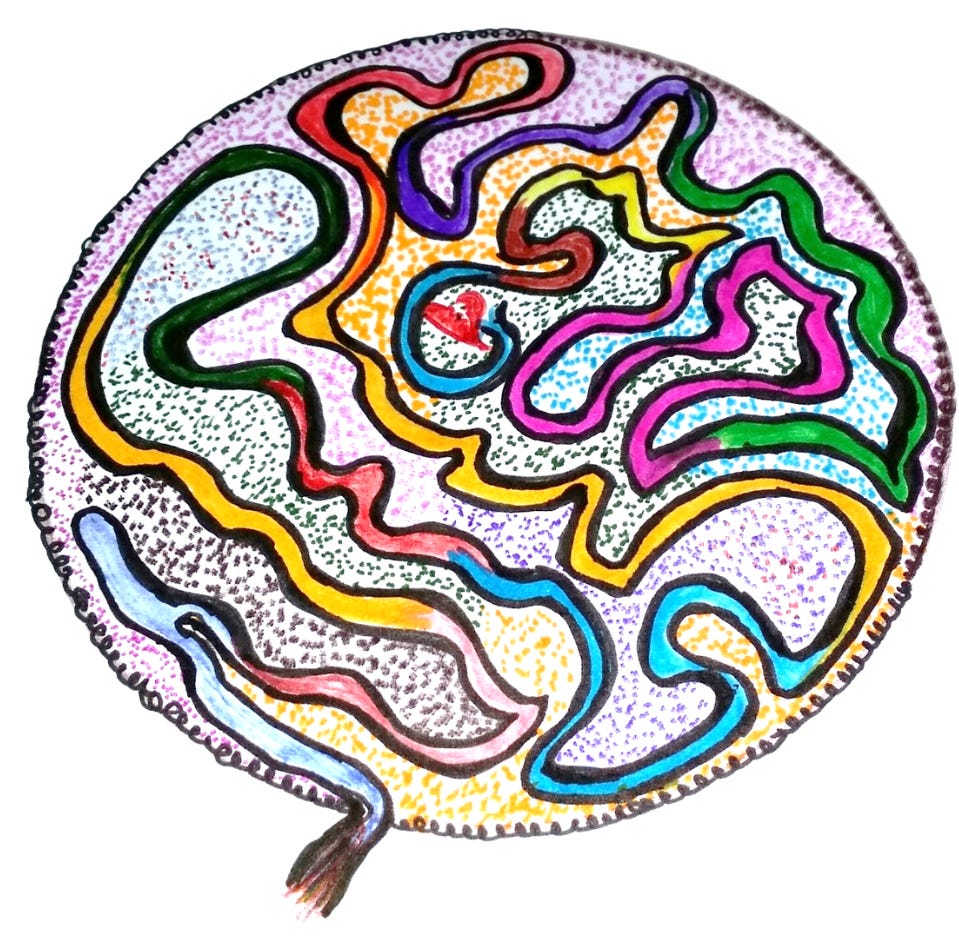
Start by drawing a circle on your paper - use the boundary of a saucer rather than a dinner plate. Somewhere inside the circle, not necessarily the centre, draw a representation of your anxiety, an unfinished task, or something else that’s playing on your mind. This representation can be as simple as a symbol, a letter of the alphabet, a stick figure, or even a word.
Take a black texta, pen or pencil and, starting from just outside the boundary of the circle, draw parallel lines, like a little road, and wind this path within the confines of the circle until it reaches your anxiety drawing. This bit can be tricky and you’ll have to concentrate, drawing one side of the track and then the other, so you keep the path even.
And here’s the quiet secret for a busy ADHD brain: the concentration the path demands leaves no room for the noise. Your hands are busy, your mind is occupied, and the endless mental ping-pong fades into the background.
When you finally reach your goal, you can start the fun part. Choose your first colour and begin to fill the track - you can use the same colour all along, or you can change colours. While you’re colouring in, start thinking about your anxiety, unfinished task or goal, and consider some of the strategies you could use to eliminate it from your life, fix it, or complete it.
When you’ve finished the path, it’s time to colour in the remaining white space - this is your mandala, so you choose how you want it to look. Draw patterns, dots, block colour, whatever you feel drawn to do.
And if you get distracted halfway through and wander off to do something else, that’s fine too. The mandala will be waiting when you come back. There are no rules and no deadline.
You’re almost finished - take the black texta and go over the lines of your path again to make them stand out. Add some shading if you want to. Pop some edging onto the boundary of the circle and you’re done.
Sit back and admire your work - it looks pretty good! You may have had some emotional reactions while creating your mandala. It’s not unusual to cry, or even start talking to yourself while you’re working. There’s nothing wrong with showing emotion.
Look at your mandala and trace the path from the outer edge to its winding end. Every turn represents a new thought about the problem, a memory, a decision.
The mandala in the illustration is one I drew years ago when I was having some serious issues with someone I considered my best friend. At the time I felt betrayed and abandoned, but by the time I’d finished the exercise I’d remembered all the great things about our friendship - and that I was as much at fault as they had been. It gave me the clarity to approach them and mend some bridges. Best thing I ever did.
About Nan
Nan Berrett is a coach and mentor for late-diagnosed women with ADHD, and the writer behind Beyond the Busy Brain. A former award-winning journalist, she has workshopped strategies for positive emotional wellbeing for years - creating and walking labyrinths, journaling, creative writing and poetry - long before she knew her own brain was wired differently. These days she teaches those same tools with the benefit, and relief, of a diagnosis. You’ll find her at nanberrett.com
And if tools like this resonate...
The Dandelion Clock, my membership for late-diagnosed women with ADHD, is available - one thing, once a month, plus weekly workbooks that turn ideas like this into small, doable steps.