

I have a theory.
The reason we find it so hard to relax is not that we do not know how. It is that our scattered minds have been sold a version of rest that looks suspiciously like productivity in disguise.
Read a book, they say. Meditate. Have a bath. But what if sitting still makes your brain itch? What if the moment you stop, a hundred tabs open in your head and suddenly you are mentally redesigning your website, drafting an email you will never send and wondering if you turned the iron off in 2019.
If I try to relax with a movie or TV series or even an audio book, after a while I split my focus between the screen and my emails or pop into my socials. When I’m listening to an audio book I often sidestep into checking my phone.
It seems that even when I do make an effort to shut off the day I can’t seem to manage to do it with any strong focus when I use electronic means. Maybe it’s guilt that I’m not getting stuff done, maybe it’s habit, or maybe my ‘entertainment’ isn’t compelling enough. I honestly don’t know.
For those of us with beautifully scattered brains, rest needs a gateway. It needs something to occupy the hands so the mind can finally exhale. It needs analog medicine.
What I mean by analog medicine
I mean the things that have no notifications, no algorithm and no measurable output beyond the doing of them. The activities that ask nothing of you except presence.
I colour in. I have a stash of books and a set of pencils that are worn to nubs and I do not care if I stay inside the lines. I used to build with Lego, running my thumb over the sharp little corners and hearing that satisfying click when the pieces meet. I do jigsaw puzzles, the old-fashioned kind with cardboard dust and a picture on the box that I never look at twice. I spread the pieces on a tray and let my eyes hunt for edges while my brain unkinks itself. I also used to knit a bit.
These are not hobbies in the sense of achievement or mastery. I will never enter a colouring competition or build the Millennium Falcon. I once knitted a complicated jumper for my now husband and he couldn’t get his head through the opening, as I’d made it too tight! The point is the sensory immersion. The repetition. The small, reliable physics of it all.
What else works for me
I walk the labyrinth in my garden. Not every day, but often enough that my feet remember the path even when my head is chaotic. Unlike a maze, a labyrinth has no dead ends. You cannot get lost. You can only keep going, and the way out is through. I have painted labyrinths on canvas and taught workshops on their mythology, yet the one in the dirt under the fruit trees is the one that holds me.
I write Morning Pages, three longhand pages of whatever is cluttering the attic. I pull a single tarot card most mornings and let the image sit with me, no interpretation required. I keep a tiny “done” book to record what I actually achieved, because a scattered brain forgets and then punishes itself for being lazy. I play word games, the kind that turn letters into patterns, because there is a peculiar calm in order emerging from chaos.
And sometimes I simply stand barefoot on the earth with my dog Charlie nearby, feeling the late afternoon warmth in the soil and pretending I know how to be still.
What would I try?
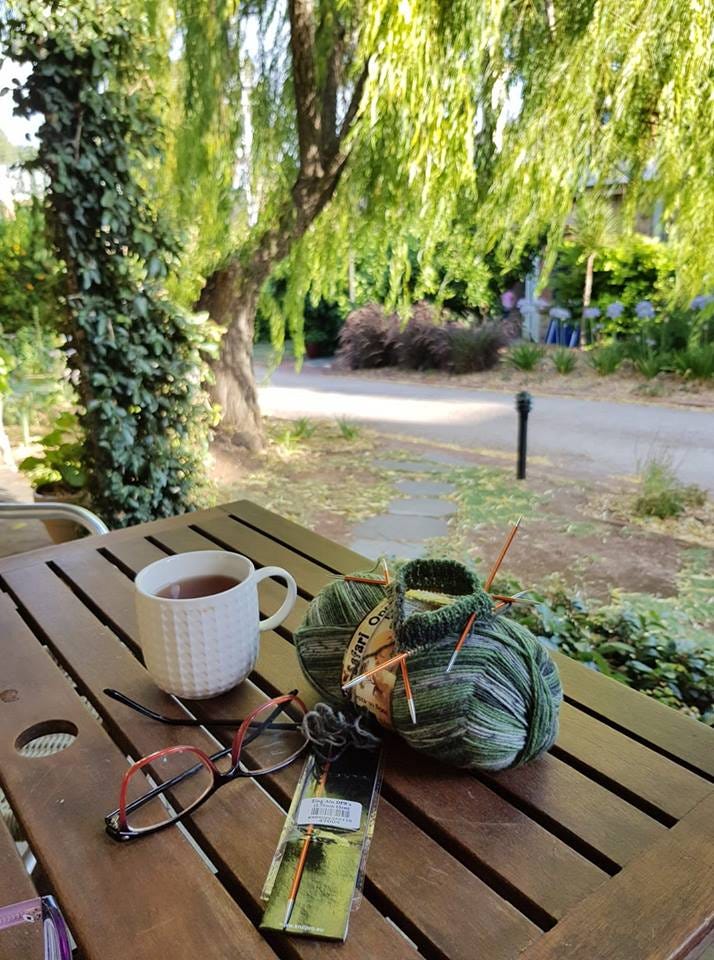
I have watched the meditative rhythm of craft groups, the click of knitting needles and the soft pull of wool, and I have wondered if my hands remember the language of creating fabric from fibre. I have eyed the Lego architecture sets and thought about building something vast and pointless over winter. I have considered buying a 1000-piece puzzle of nothing but sky, the ultimate test of whether I can tolerate ambiguity.
I think I would like to try painting rocks.
There is something about taking a plain rock and creating art that brings it to life. This appeals to the part of me that believes we are all changing into something different than before.
More recently I’ve purchased a miniature watercolour painting kit. It comes with its own little palette, brush and paper with designs already pre-sketched. I am waiting for the right moment to use it. Maybe tomorrow.
Now your turn
I am genuinely curious. What do you use? What is your analog medicine? Is it the garden, the guitar, the sourdough starter, the embroidery hoop? And what would you try if you gave yourself permission to be bad at it?
Drop a comment. I read every one, usually while half-finished puzzle pieces sit waiting on the table beside me.
Nan Berrett is a late-diagnosed ADHD coach and the Keeper of the Dandelion Clock, a community for late-diagnosed (and undiagnosed) women with ADHD and the author of Beyond the Busy Brain, a Substack for people whose minds move faster than their lives allow. She lives in the Clare Valley with her husband Dave, her dog Charlie and more half-completed creative projects than she will admit.
I am pruning the glory vine. It's nearly too late in the season because it's starting to shoot, and I expect it to bleed.
There's a rhythm to grapevine pruning.
Fruiting vines have two kinds of cuts: rods and spurs. Rods are cut back to seven nodes, and spurs are cut right down to two nodes. One is for this year's fruit, and one is for next year's fruit. I always forget, because I get stuck in the rhythm of rods and spurs.
The glory vine is different. It's grown for shade and its amazing maroon leaves in autumn. I didn't prune it last year, due to a bad knee preventing me from climbing onto the moveable platform, which is safer than a ladder.
The knee is still unhappy but I am persevering and enjoying shaping the trellis, leaving long rods and trimming the older growth to spurs.
It's a bit of a hack job, but has its own rhythm.
Next will be the roses (all seven of them) then repotting the figs.
Winter in the garden might be chilly, but it's relaxing.